
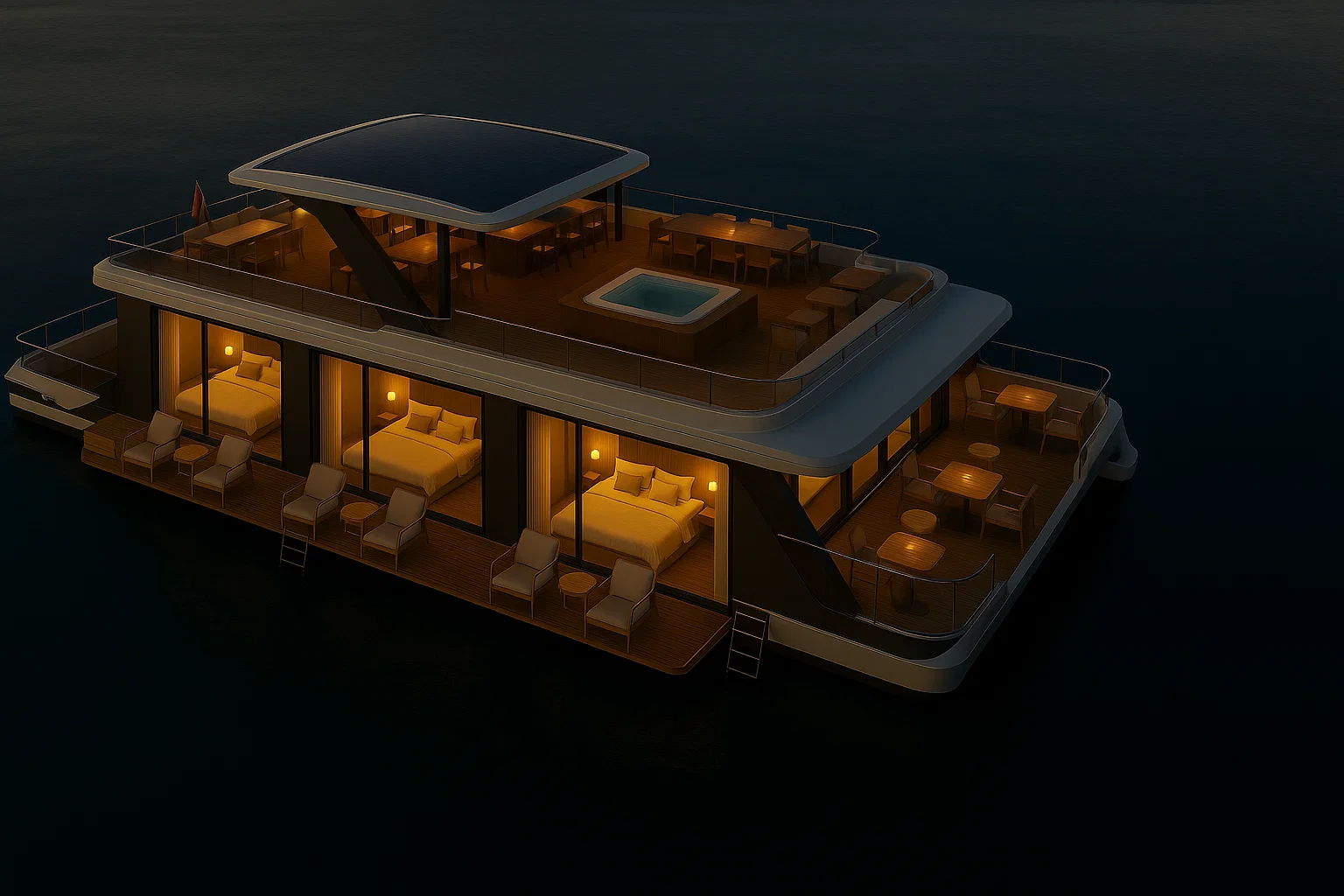
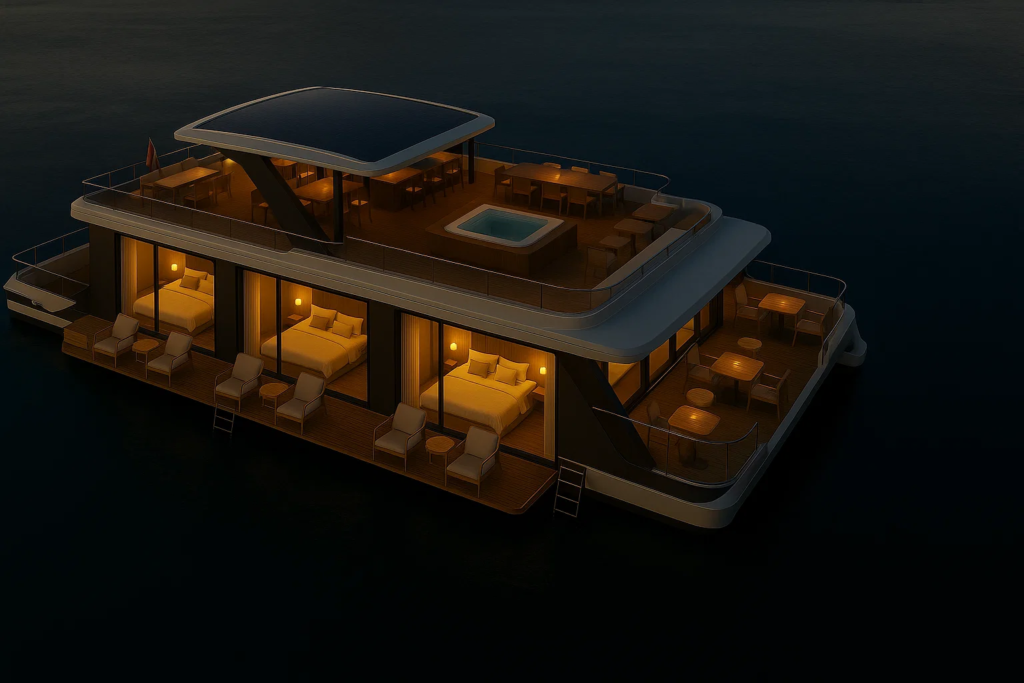
Coastal destinations around the world are facing the same challenge: limited land, rising real estate costs, and increasing pressure on waterfront development. As demand for unique travel experiences continues to grow, traditional hotel models are struggling to adapt. This is where a new concept begins to take shape — floating hotels.
Floating hotels are not simply accommodations placed on water. They represent a fundamental shift in how hospitality, architecture, and mobility come together. Instead of expanding horizontally on scarce land, hospitality moves onto the sea — flexible, modular, and inherently connected to its surroundings.
Why Traditional Hospitality Is Reaching Its Limits
Waterfront land has become one of the most valuable and restricted assets globally. Regulatory constraints, environmental concerns, and long development timelines make new coastal hotel projects increasingly complex.
At the same time, modern travelers are no longer satisfied with standard luxury. They seek experiences — proximity to nature, privacy, originality, and a sense of place. Traditional hotels, even high-end ones, often struggle to deliver this without significant compromises.
Floating hotels emerge as a response to these limitations, offering a new layer of freedom for both operators and guests.
What Defines a Floating Hotel?
A floating hotel is designed to operate as a fully functional hospitality unit on water. Unlike conventional vessels or retrofitted boats, these structures are purpose-built for living, hosting, and operating over extended periods.
Key characteristics include:
- Stable, seaworthy platforms designed for comfort rather than speed
- Spacious interiors comparable to high-end hotel suites
- Full hotel-grade utilities and systems
- Modular layouts that allow scalability and flexibility
The result is a hospitality space that feels less like a vessel and more like a floating villa — seamlessly integrated with its environment.
The Guest Experience: Living With the Sea, Not Beside It
Floating hotels redefine the relationship between guests and water. Instead of viewing the sea from a distance, guests wake up directly on it. Natural light, open horizons, and the gentle motion of water become part of the experience.
This proximity creates a sense of calm and exclusivity that traditional hotels rarely achieve. Whether anchored near a quiet bay or positioned alongside a vibrant coastline, floating hotels offer a unique balance between privacy and connection.
For guests, it is not just a stay — it is a different way of inhabiting space.
Operational Advantages for Hospitality Brands
Beyond guest experience, floating hotels offer practical advantages for hotel operators and investors:
- Reduced land dependency: No need for large coastal plots
- Faster deployment: Modular units can be built and installed efficiently
- Scalability: Projects can expand incrementally rather than all at once
- Mobility: Units can be relocated or repositioned based on demand or season
These factors translate into greater flexibility, controlled investment risk, and the ability to adapt to changing markets.
Minoa’s Perspective: Floating Hospitality, Reimagined
At Minoa, floating hotels are approached not as experimental concepts, but as long-term living and hospitality solutions. Drawing from shipyard engineering experience and offshore living principles, the focus is on durability, safety, and real-world usability.
Rather than adapting existing vessels, Minoa designs floating hospitality units from the ground up — prioritizing stability, spatial comfort, and long-term operation. The goal is simple: create floating hotel spaces that feel natural to live in, effortless to operate, and timeless in design.
This philosophy bridges the gap between luxury living, marine engineering, and hospitality — opening the door to a new category of water-based experiences.
Looking Ahead
As coastlines become more constrained and traveler expectations continue to evolve, floating hotels are poised to play a significant role in the future of hospitality. They offer a sustainable, flexible, and experiential alternative to traditional development — one that aligns with both environmental realities and modern lifestyles.
Floating hospitality is no longer a vision of the future. It is already taking shape on the water.
About Minoa
Minoa designs and builds offshore-capable floating living concepts, exploring new ways of life, hospitality, and long-term living on water.