
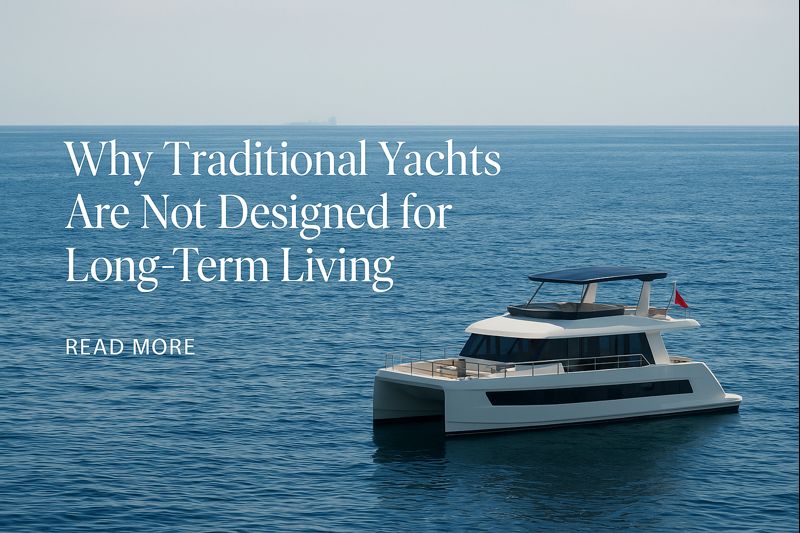
.Traditional yachts are remarkable machines. They are engineered for movement, performance, and short-term comfort. But despite their sophistication, most yachts are not designed to support long-term living.
This distinction is often overlooked. A yacht that feels luxurious for a week-long cruise can become restrictive, tiring, or impractical when used as a permanent living space. The difference lies not in quality — but in intent.
Yachts Are Designed for Travel, Not for Living
The primary purpose of most yachts is navigation. Speed, handling, and efficiency shape their design decisions. Interior layouts, weight distribution, and system placement are all optimized around movement.
As a result:
- Living spaces are compact by necessity
- Ceiling heights are limited
- Storage is optimized for short trips
- Systems are designed for intermittent use
These choices make sense for cruising — but they create limitations for daily life.
Short-Term Comfort vs Everyday Comfort
Luxury on a yacht is often measured by finishes, materials, and visual appeal. Long-term comfort, however, is defined by different factors.
Living comfortably over months requires:
- Generous interior volumes
- Clear separation between living, sleeping, and technical spaces
- Quiet operation of systems
- Natural light and visual openness
Without these, even the most beautiful interiors can begin to feel restrictive over time.
The Hidden Challenge: Systems and Autonomy
Most traditional yachts rely heavily on marina infrastructure. Power, water, waste management, and maintenance routines are often designed around frequent dock access.
For long-term living, this dependency becomes a constraint.
Sustainable offshore living requires:
- Systems designed for continuous operation
- Larger capacities and redundancy
- Easy access for maintenance
- Balanced energy and water management
These elements are rarely prioritized in conventional yacht design.
Psychological Space Matters
One of the least discussed aspects of long-term living on water is psychological comfort. Movement, noise, limited space, and constant adjustment can quietly impact daily well-being.
Living platforms designed for long-term use place emphasis on:
- Stability at anchor
- Reduced motion and vibration
- Visual calm and spatial clarity
- A sense of permanence
Without this, life on water can feel temporary — even when it is not intended to be.
A Different Design Philosophy
The gap between yachts and long-term living platforms is not a matter of size or luxury level. It is a matter of philosophy.
Designing for living means starting with questions such as:
- How does daily life unfold onboard?
- Where do routines happen naturally?
- How does the space feel after weeks, not days?
When these questions guide the process, the result is no longer a yacht in the traditional sense.
Where the Floating Home Concept Begins
Floating homes and long-term offshore living platforms are designed from the inside out. Navigation remains important, but it does not dominate every decision.
Instead, priorities shift toward:
- Spatial comfort
- Stability and predictability
- System reliability
- Everyday usability
This approach creates environments that feel closer to homes than to vessels — while remaining fully seaworthy.
Minoa’s Perspective
At Minoa, this distinction defines every project. Designs are not adaptations of existing yacht templates, but purpose-built platforms developed for long-term living and hospitality on water.
Drawing from shipyard engineering experience, Minoa focuses on structural integrity, livability, and systems that support real life offshore — not just short stays.
The result is a new category: not a traditional yacht, not a stationary structure, but a floating living environment designed for permanence.
Beyond the Traditional Yacht
Traditional yachts excel at what they are designed to do — travel, explore, and perform. But long-term living demands a different approach.
Understanding this difference is the first step toward redefining how life on water can truly work.
About Minoa
Minoa designs offshore-capable floating living concepts, bridging shipyard engineering with long-term comfort on water.
In today’s competitive market environment, the body copy of your entry must lead the reader through a series of disarmingly simple thoughts.
If you want to read, I might suggest a good book, perhaps Hemingway or Melville. That’s why they call it, the dummy copy.